ALFA Performance June 1999
Diffraction limited imaging with the Laser Guide Star!
Diffraction limited imaging with the Laser Guide Star!
Check out our results and list of publications pages for more information.
ALFA Performance September 1998
Please have a look at our recently submitted paper:
Observational Results from ALFA with Natural and Laser Guide Stars
Abstract:
The sodium laser guide star adaptive optics system ALFA, which is installed at the Calar Alto 3.5-m telescope, has been undergoing an intensive optimisation phase. Observations using natural guide stars that are presented in this paper, show that for bright stars (mv<~8) it is now possible to reach K-band Strehl ratios in excess of 60% and to easily resolve binaries at the diffraction limit of the telescope. In more typical usage Strehl ratios in the range 10-15% can be achieved over a wide field (~2 arcmin); and the limiting magnitude is currently mv~12.5. We also present some of the first spectroscopy at diffraction limited scales, showing we are able to distinguish spectra of binary stars with a separation of only 0.26". Our last set of results are on Abell galaxy clusters, including a correction on a galaxy using the laser guide star as the reference. There are still a number of difficulties associated with the laser, but our best result to date is of the galaxy UGC 1347 in Abell 262. Correcting tip-tilt on a star 41" away and higher orders on the laser, we achieved in increase in peak intensity of 2.5, and a reduction in FWHM from 1.07" to 0.40". It is expected that further significant advances will be made in the next 6 months and beyond.
Read entire paper in pdf format.
ALFA Performance August 1998
|
vs. seeing and reference star brightness in V-band |
|||||||
| Guide star |
Seeing in V [arcsec] |
No. of Subap- ertures |
Loop band- width [Hz] |
Corrected FWHM [arcsec] |
Corrected Strehl [%] |
Loop robust- ness |
WFS signal/ noise |
| Bright NGS mv~7 |
1.3-1.8 0.9-1.2 |
30 30 |
90 90 |
<=0.25 <=0.15 |
~25 ~40 |
++ ++ |
>100 >100 |
| Faint NGS mv~10 |
1.3-1.8 0.9-1.2 |
18 30 |
20 20 |
<=0.3 <=0.25 |
~10 ~20 |
+ ++ |
10-20 10-20 |
| Very faint NGS mv~12 | 1.3-1.8 0.9-1.2 |
6 18 |
10 6 |
? 0.4 |
? ~8 |
+- + |
<=5 <=5 |
| LGS mv~10 |
1.3-1.8 0.9-1.2 |
6 6 or 18 |
6 6-10 |
<=0.5 <=0.4 |
2-3 ~4 |
+- + |
<=5 <=5 |
| Lick LGS mv=7 |
0.8 | 37 | 30 | 0.3 | 9.1 | ? | ? |
| ESO ADONIS mv=12 |
< 1 | 32 | 10 | 0.3 | 9 | ++ | ? |
ALFA Status February 1998
Adaptive optics status
In February 1998 Team ALFA had 5 clear nights with partly excellent seeing conditions. The adaptive optics part of ALFA was again improved. The best result so far was taken on a mV = 9.7 star (T Tau) while the AO system was operated at 200 Hz correcting for 24 modes (18 subapertures). The tip-tilt loop was closed with 100 Hz. Using an improved centroid algorithm we achieved a peak increase in the H band by a factor of 5. The corresponding FWHM was reduced to 0.24". In natural guide star mode we could further close the AO loop on GM Aurigae (mV = 12.3) while the AO system was operated at 60 Hz correcting for 7 modes (6 subapertures). The closed-loop sensitivity of the new tip-tilt tracker camera was measured with mV = 14.5. This is still one magnitude below the required sensitivity. Since the CCD chip was not operated at the lowest possible temperature we have to repeat this measurement in our next observing run.
Laser guide star status
The laser guide star becomes more and more the standard adaptive optics guide star. Its magnitude is around mV = 10.5. Observations at small zenith angles can now be routinely carried out. We also tried measurements at larger zenith angles, on a night with mediocre transparency (airmass: 1.6) where the LGS focus moves to about 180 km. At this distance, which is about twice the distance at zenith, the LGS brightness went down by a factor of approx. 4. Although the LGS was detectable by the wave front sensor, the signal to noise ratio was too small to close the high order adaptive optics loop.
ALFA Status December 1997
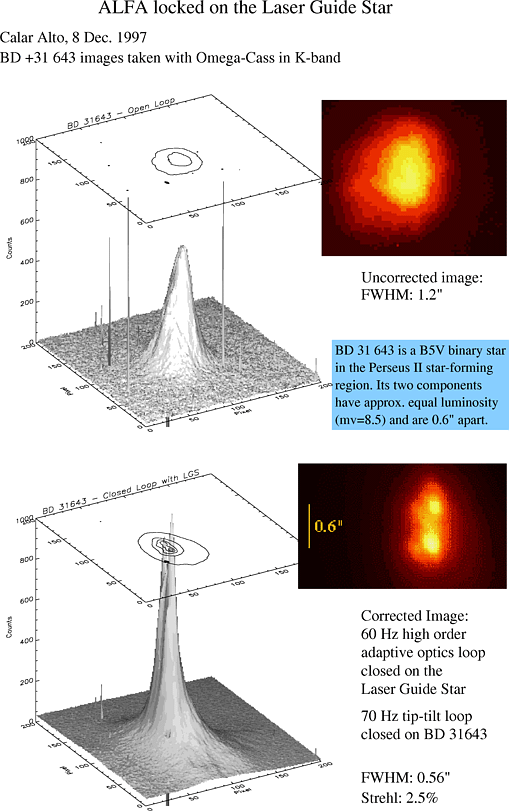
Three clear nights in November and December have demonstrated that ALFA - its adaptive optics (AO) and Laser Guide Star (LGS) system - is a powerful instrument for all kinds of astronomical research.
AO Sensitivity
The AO system has been operated in closed-loop mode on natural guide stars down to mV = 11.8. Certainly there were only little improvements on the image quality of observed objects because no more than six subapertures were used to measure and correct for nine modes at a frequency of 60 Hz.
The new EEV CCD39 based tip-tilt tracker camera has been tested (on natural guide stars with mV < 14) and worked as well as the old tracker camera. Sensitivity measurements will be made in February 1998.
AO + LGS
For the second time ALFA was locked on the laser guide star while images on BD 31643 were taken. The results show clearly that ALFA starts working as expected.
ALFA Status August 1997
AO Sensitivity
The AO system has been operated in closed-loop mode on guide stars down to mV = 9.7, with a beam splitter in place which sends only 38% of the light to the wavefront sensor (and 38% to the tip-tilt camera). Without the beam splitter, itwill thus be possible to lock on stars down to mV = 10.7 (to be verified in the next ALFA run in September 1997).
AO System
The closed-loop operation is now extremely stable down to pretty bad Seeing conditions (3"). The progress in terms of reliability of the closed-loop is mainly due to (1) applying better adapted control-loop parameters for the selected bandwidths (Gain, Alpha, a2) and (2) improvements in the way the gradients are calculated (centroiding algorithm: center of moment algorithm).
The image quality has been improved, mainly by using a better geometry of the lenslet array, which covers the telescope pupil in a more symmetric way.
The Strehl ratio, however, has to be improved still even the latest results look promising.