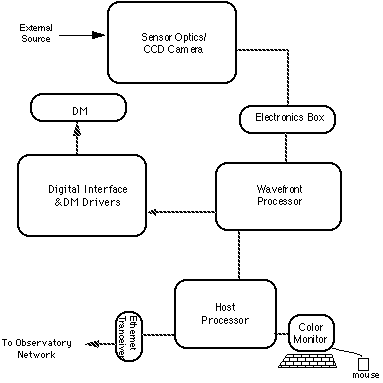
The Atmospheric Compensation System uses the Shack-Hartmann method to measure the optical wavefront received by the telescope. The sampling optics that select the portion of the spectrum covered by the sensor were provided by the user. It provides both a diagnostic and analysis tool for the characterization of atmospheric wavefronts and a real-time compensation system. It comprises the Shack-Hartmann wavefront sensor with low-noise CCD camera, the wavefront processor which converts the raw camera data to calibrated OPD maps or Deformable Mirror drive signals, the Electronics Box which contains assorted power supplies and interfaces, and associated cables and peripherals. The color graphical user interface (GUI) allows for a simple operation and the use of EPICS as the standard interface allows easy integration into other observatory systems. shows the block diagram of the Atmospheric Compensation System.
Figure 1.1 Atmospheric Compensation System Block Diagram
The optical head is shown in Figure 1.2. Following the light from the entrance aperture we come first to the tracker/WFS splitter. Three choices are available for this element: clear for tracker only operation; a dichroic that puts the red end of the admitted spectrum through to the tracker and the blue end to the WFS; and a Na D line reflector for Laser Guide Star (LGS) operation. The tracker leg consists of a reimaging lens that provides the correct image scale for the Astromed camera, a filter wheel with neutral density filters, and the CCD camera head itself. The camera is mounted on a three axis stage for acquisition of a track object.
In the WFS leg there is a pupil reimaging lens that relays the telescope pupil onto the WFS target selection mirror. This mirror allows the WFS axis to be steered up to 30" off the science instrument axis. After the steering mirror there is a reimager that relays the f/25 focus to the aperture stop. The aperture stops are comounted with the f/25 reference fiber on a linear stage. Next in the optical path is the collimator that relays the pupil to the Hartmann lens array. There are five lens arrays mounted on a linear stage. The final element in the system in the relay lens mounted on the MIT/LL CCD camera head. This camera is on a linear stage to allow shifting from pupil imaging to spot imaging.
The optical head needs a shroud for stray light suppression and thermal management.

FIGURE 1.2a Optics Head

FIGURE 1.2b Optics Head Layout
The On Telescope Electronics Rack encloses all the electronics that must be close to the optics head (with the exception of the Astromed controller). Included are the drivers for the motorized stages, the power supplies for the LLCCD, the PI tip-tilt mirror driver and interface. Figure 1.3 details the whole of the electrical system and indicates the entity responsible for each portion.
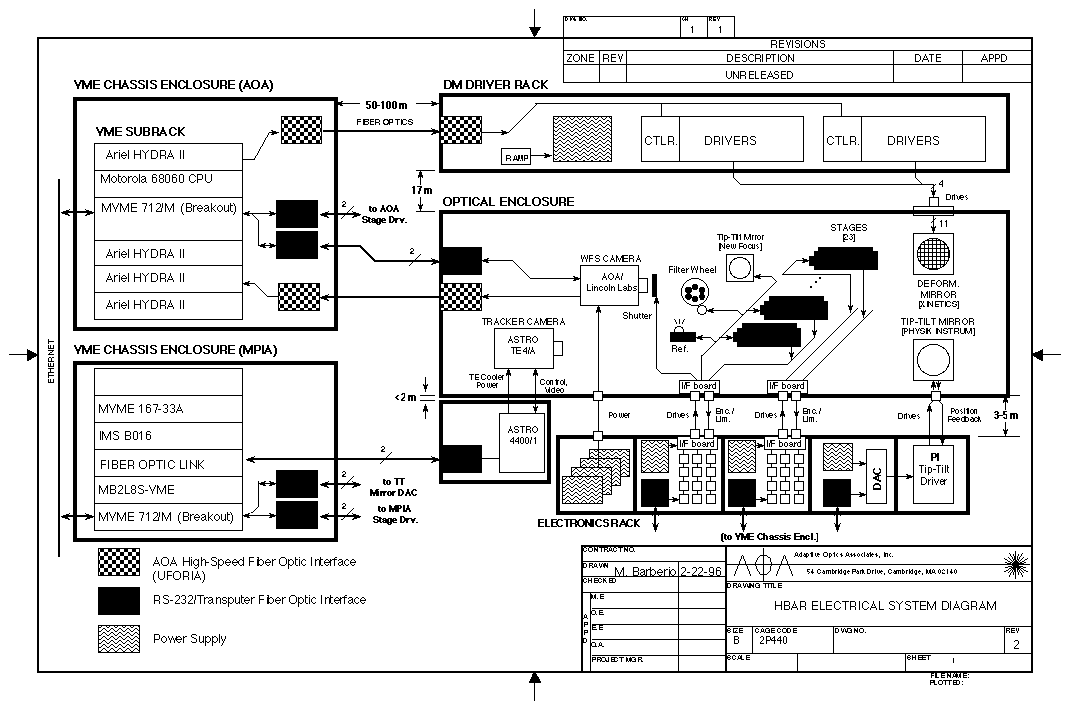
FIGURE 1.3 Electrical System Block Diagram
The interface between the VME chassis and the LLCCD camera is via a custom fiber optic link called UFORIA-T (Transmitter). This configuration of UFORIA is located next to the LLCCD camera. It receiver electrical power from the LLCCD camera.
The interface between the VME chassis and the Xinetics DM drivers is via a custom fiber optic link called UFORIA-R (receiver). This link is similar to that used for the LLCCD camera except for configuration ROMs and cabling. It is located near the DM driver rack and receives power from an external AC adaptor.
The UFORIA-VME is equipped with a transmitter and receiver pair. It is packaged in a 6U VME card configuration. It is located and powered from the real-time VME rack.
The Atmospheric Compensation System has several types of computer hardware with software distributed across many processors. TMS320C40 digital signal processors (DSP's) are the core of the system. All real-time processing takes place on the DSP's which reside on Ariel quad-processor Hydra II boards. A 21 slot, 6U VME chassis houses the Hydra II's along with a Motorola 68060, MVME177, for real-time systems control. A SPARC station 20 acts as the operator console providing a graphical user interface (GUI) as well as data analysis tools and storage media. The SPARC station and the 68060 are connected over Ethernet on the Calar Alto local area network. A schematic of the system is given in Figure 1.4.
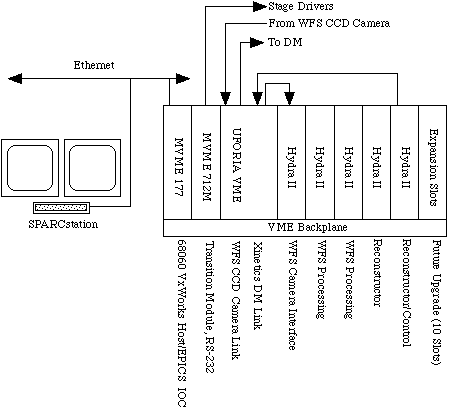
Figure 1.4 Processor Configuration
The Operator console consists of a SPARC station 20 with two 75 MHz Super SPARC processors. The workstation and all of its accessories were supplied by MPIA. Two color monitors are supported by the system. A total of 10 GB (unformatted) of disk space exists on the system. The workstation serves as the primary operator console to the adaptive optics system. The graphical user interface and data display programs can be configured by the user to use both monitors. Data storage as well as system software reside on the workstation's disk drives. Information can be exchanged with the VME system via the existing Ethernet network in the telescope.
The real-time host is the MVME177-003 with an MVME712M transition module. The MVME177-003 is a Motorola 68060 running at 50 MHz with 16 MB of DRAM. This VME single board computer acts as the VME system controller. The MVME712M Transition module is the MVME177's interface to its I/O devices: ethernet, serial and parallel ports. The MVME177 runs software to control the Hydra II boards. It also acts as an EPICS Input/Output Controller (IOC) allowing the adaptive optics system to interface to the other telescope systems. Control of the IMS483 micro stepper motor drivers is through one of the MVME177's serial ports on the MVME712M.
All real-time processing uses Hydra II boards made by Ariel Corp. Each Hydra II is a 6U VME board and has four 50 MHz Texas Instruments TMS320C40 Digital Signal Processors. Each DSP has six bi-directional 8-bit parallel communication ports (CommPorts) running at 20 MHz. Three CommPorts per DSP are used for on-board interprocessor communications. The other three are available on the front-panel for board-to-board communication and interfaces to external devices (12 total). Also on the front-panel of the board is an RS232 port which is connected to DSP 1. Each board has a VME slave interface and 64 MB of DRAM. This DRAM is accessible by each DSP and by other devices on the VME bus. Two Hydra II models are used: HY2-4-S2 and HY2-4-S3. The -S2 model has 2 MB SRAM per board and the -S3 has 8 MB SRAM per board. The larger memory of the -S3 boards is for high-speed data collection (full frame rate gradient data).
The processing for the adaptive optics loop (Acquisition, WFS, Reconstruction, Control Signals) takes place on the five Hydra II's (two HY2-4-S3's and three HY2-4-S2's). One board performs data acquisition from the CCD camera using its CommPorts. Two boards compute gradients for the WFS and two boards perform reconstruction and compute DM drive signals. The drive signals are sent to the Xinetics DM from a CommPort via UFORIA links. All real-time data is passed using the CommPorts of the DSP's. Non-real time data passes over the VME backplane. This data consists of quick-look uploads and health/status/control messages.
The Tip/Tilt Processor consists of a separate VME chassis supplied by MPIA. This processor interfaces to the MPIA supplied Astromed Camera and to the PI tilt mirror driver. The software for this processor was also supplied by MPIA.
The software for the adaptive optics system runs under two operating systems: Unix (Solaris 2.4) and VxWorks (5.2). All software is written in C or Tcl. Some small sections of time-critical real-time software are written in TMS320C40 assembly language. The software can be logically and functionally broken into three groups: host software running under Unix on the SPARC station, control and interface software running under VxWorks on the MVME177, and real-time software running on the DSP's.
The host software provides a graphical user interface, instrument control, and data collection and analysis tools. All host software is based on Tcl. Tcl is a high-level, freely available, interpreted scripting language designed for control and administration tasks. Tcl is designed to be extended by the developer by linking in C language libraries. Tcl is command-line driven. Tk is a graphical extension to Tcl that uses the X windowing system. The GUI is written in Tk. All AOA adaptive optics systems and software use a Tcl interface. AOA developed graphical data displays use Motif but are accessible from Tcl.
Direct control of the hardware and real-time processing takes place under VxWorks. Using TCP/IP connections and a client/server model these VxWorks tasks are accessible by a Tcl shell running on the Unix workstation. The developer or end-user can operate and interrogate the real-time subsystems interactively from Tcl. This includes operating the motorized stages, setting parameters for the AO and T/T loops, and uploading data.
The GUI is based on Tcl and Tk. The GUI will allow full control of the instrument. In order to prevent the inexperienced user from improperly configuring the system the GUI has two access modes: operator and engineer. In operator mode some actions are restricted. In engineer mode all operations are allowed.
The system is able to display data from the sensors during operation. Two operating modes are supported: data collection and normal operation. During normal operation the AO and/or T/T loops are running. The data is sampled as rapidly as the system and network load will allow (estimated at approximately 1 Hz). The data can also be stored to disk under user control. The data files are saved in FITS (Flexible Image Transport System) format with AOA extensions. Raw values from the system are available for display and/or storage: Camera images, spot motion gradients, wavefront modes, and DM drive signals. In addition, data computed from the raw data is available for display/storage: OPD, PSF, PTF, MTF, Strehl, r0 and t0. During data collection mode only the WFS camera and the WFS are operating. No updates of the DM take place. Five seconds of continuous spot motion gradients and/or centroids are collected and later uploaded and stored. All data collected can be post-processed using analysis tools available in Wavelab®, AOA's Wavefront analysis library which is supplied with the system.
The various subsystems send health and status messages to a central event logger. This logger monitors the streams for events requiring operator intervention or notification. Such events trigger a voice annunciator system. The annunciator uses the speaker capabilities of the MPIA-supplied SPARC station to issue context appropriate pre-recorded English language messages.
Tasks running under VxWorks can directly control the operation of the real-time subsystems: stages, adaptive optics, and tilt compensation. The software comprising these three subsystems allows commands from the VxWorks shell, from other VxWorks tasks or from remote processes to control the system and collect data.
A VxWorks software module controls the IMS483 stepper motor drivers and their associated stages. A user can access the IMS483's parameters and operate the stages from this software interface. In addition, tasks are created to monitor the stages and report their position and state. Communication with the IMS483 drivers is via an RS232 serial port on the MVME177.
The interface software for the adaptive optics subsystem allows downloading of parameters and tables, upload of raw data, control of the AO loop, and subsystem diagnostics.
The interface software for the Tip/Tilt compensation subsystem is provided by MPIA..
The atmospheric correction system interfaces to the Telescope control system and Laser Guidestar system via EPICS. The following AOA system parameters are available as EPICS database records: Tip/Tilt seen by the WFS, image intensity on the WFS camera, Tip/Tilt correction required of the telescope, focus correction required of the telescope, AO loop On/Off, AO loop opened/closed, Tip/Tilt loop On/Off, Tip/Tilt loop opened/closed. The following data are needed by the AOA system: Telescope position and laser guidestar On/Off state.
AOA developed an EPICS device driver to interface to the IMS483 drivers. This driver allows control of the stages and the IMS483 digital I/O lines from EPICS. The device driver connects to the standard EPICS database record types steppermotor, mbboDirect, and mbbiDirect, for stage control, digital out, and digital in, respectively.
All real-time software for the system runs on the digital signal processors. The processing by necessity is distributed across multiple DSP chips. Processor-to-processor communications is done over the CommPorts of the DSP's. Quick-look data is made available by the DSP's on the shared DRAM.
Each CCD camera frame has offset and gain corrected on a pixel-by-pixel basis. The correction tables are software selectable.
To compute spot motions from Hartmann spots one of two algorithms are used: centroid or least-squares fit. The centroid calculation computes weighted sums for each subaperture. The spot fitting algorithm computes a least-squares fit for a parabola around the peak of the subaperture. The estimated spot location from either algorithm is then subtracted from a reference spot location to obtain the spot motion gradient. The choice of algorithms is user selectable during experimental setup. The gradients are passed to the reconstructor.
The reconstructor takes gradients from the WFS and produces modal coefficients. The modal representation use an orthonormal basis. The modes used in the reconstruction can be selected by the user during experimental setup. The gradients-to-modes conversion is done by a matrix multiply. The matrix combines a standard least-squares fit reconstructor matrix and a modal projection matrix determined by the modes selected. The modal coefficients are then passed to the control algorithm.
The control algorithm takes the modal coefficients and passes them through a compensation filter to provided compensated modal coefficients. The algorithm provides proportional-integral control plus filtering of up to 3rd order. The resulting actuator voltages are offset by bias voltage values and sent to the deformable mirror.
The tip/tilt sensor algorithm is provided by MPIA.
The system has available five modes:
* Track Only
* Atmospheric Compensation Only
* Track and Atmospheric Compensation
* Data Collection
* Diagnostic
Perform Tip/Tilt correction only.
Perform atmospheric correction only.
Perform full system correction using the tracker loop and the adaptive optics loop.
Perform data collection. The data that can be collected in this mode are: camera images for computing offset and gain tables, WFS gradients, Tip/Tilt centroids. No updates of the DM or TTM take place in this mode.
Perform system level diagnostics.