The ALFA Laser-Guidestar System - An Overview
W. Hackenberg, H.-C. Holstenberg, A. Quirrenbach, N. Wilnhammer
Max-Planck-Institut für extraterrestrische Physik (MPE)
Garching, Germany
ALFA is the collaborative MPI für Astronomie/MPE adaptive optics experiment with sodium laser guide star(LGS) at the 3.5 m telescope on Calar Alto(Spain). The scientific goal of this project is diffraction-limited imaging and spectroscopy in the near-infrared at any point in the sky.
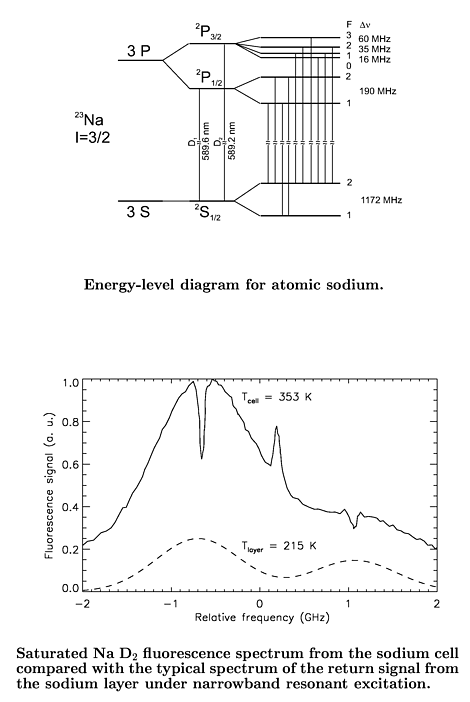
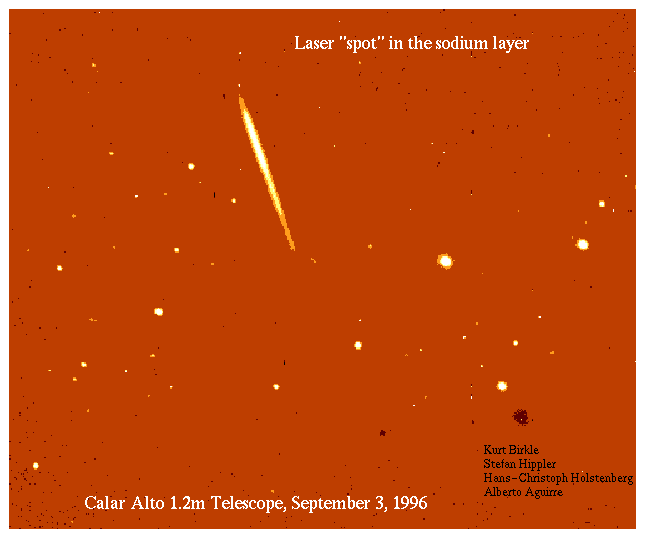
The ALFA LGS is produced by focusing a laser beam into the mesospheric sodium layer which is at a mean altitude of about 92 km. The narrowband laser is tuned to the sodium D2 line at 589.2 nm, so that the sodium atoms in the layer produce resonance fluorescence at this wavelength when excited by the laser light. Since the sodium layer has a total thickness of about 10 km at its mean height, the LGS as seen from the ground is the fluorescence light from a column about that value long (depending on the zenith distance the laser is pointing).
The sodium layer was chosen for generating the LGS mainly for two reasons: First, due to the finite height of any atmospheric LGS, the light cone from the LGS samples the atmospheric turbulence uncompletely in the outer parts of the entrance pupil of the telescope. In the case of a 4 m class telescope, however, a single sodium LGS is high enough, so that this cone effect is neglegible when observing in the near-infrared. Secondly, when using the sodium atoms in the mesospheric layer the product of particle column density and absorption cross section is maximized, given today's laser technology for induced fluorescence.
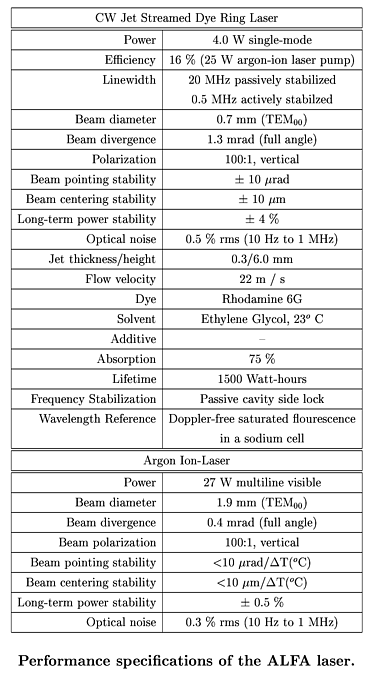
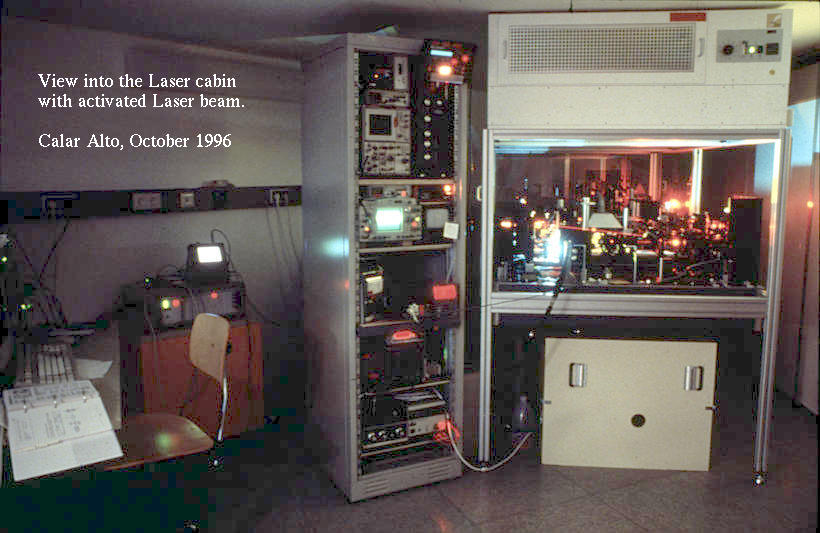
The ALFA laser for exciting the sodium D line is based on a Coherent Modell 899 continuos-wave dye jet ring laser using Rhodamine 6G.
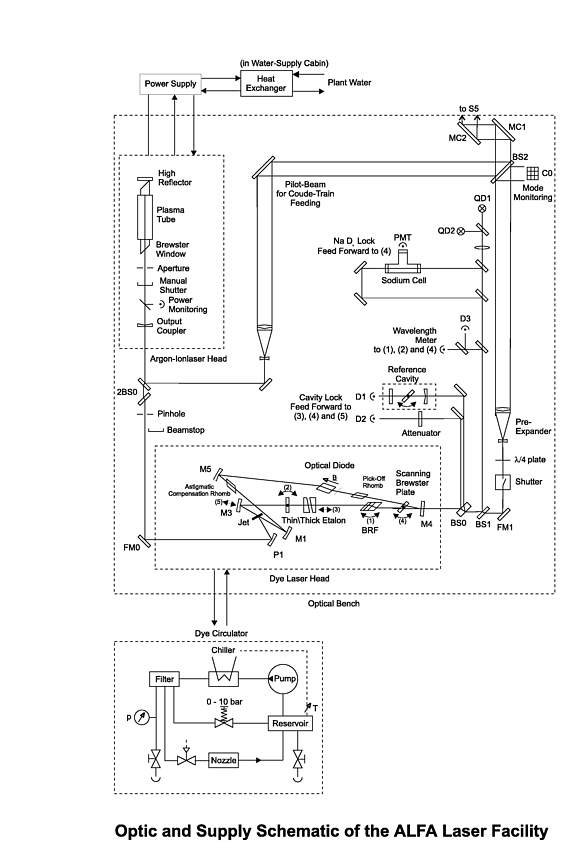
The dye laser is pumped with the 25 W multiline output of an argon-ion laser(Coherent Innova 400). The typical output power of the dye laser is 4 W single-mode with good mode quality. This corresponds to a calculated V-band LGS brightness of 9 to 12 mag depending on zenith-distance and sodium column density. Frequency-stabilization and absolute wavelength tuning of the dye laser is done by locking it to an external reference cavity and to the lamb dip signal of a labaratory sodium cell.
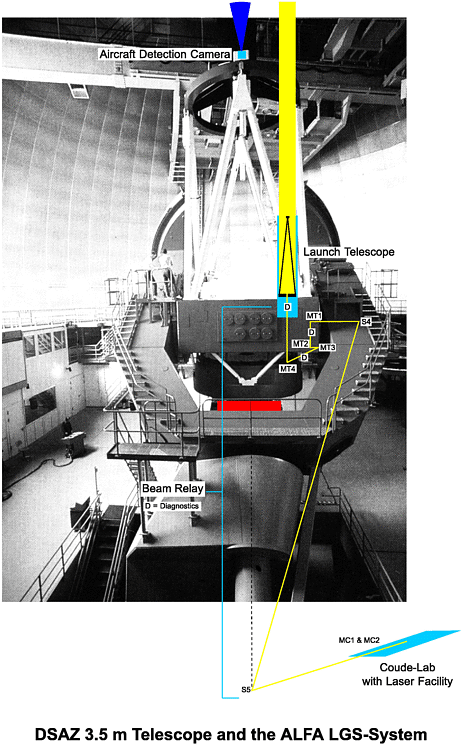
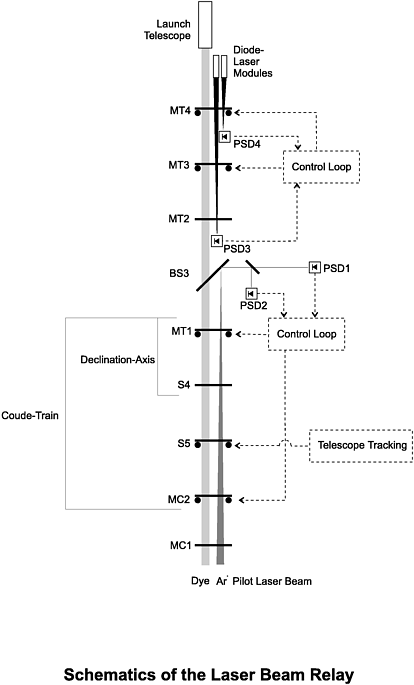
Both lasers, together with optics for beam forming and diagnostics are installed in a separate room in the coudé-lab of the 3.5 m telescope building, where one has access to a spatially fixed focus of the main telescope. From the coudé-lab the laser beam is fed into the coudé-train of the 3.5 m telescope. Near the 3.5 m primary mirror the beam is picked off by a folding mirror, which directs the beam with the help of additional steering mirrors to an 0.5 m launch telescope which expands the laser beam and which provides focusing and beam steering capabilities. Since the launch telescope is mounted at the side of the primary mirror the Rayleigh backscatter produced by the beam in the lower atmosphere can be simply rejected from entering the wave-front sensing camera by limiting the field of view of the sensor to about 10 arcsec, which is twice the angular separation of the LGS from the end of the Rayleigh backscatter cone.
To keep the dye laser beam aligned on the axis of the launch telescope independently of the main telescope's motion, telescope flexure and irregularities in feeding the laser into the coudé-train, the position signals from three additional pilot laser beams are used to drive two control loops for beam centering and pointing. From the start of the coudé train to the exit of the launch telescope the beam is baffled for turbulence and safety reasons.
An aircraft detection system has been installed to automatically block the laser beam whenever an aircraft enters the area close to the beam.